Showing posts with label Reginald Collin. Show all posts

Saturday, April 8, 2023

Callan: This Man Alone.

Callan dots the covers of issues of TV Times.
Callan dots the covers of issues of TV Times.

Release Date: Feb. 1, 2016. Written by: Thomas Cock and Steve Rogers. Directed by: Thomas Cock. Executive Producer: Tim Beddows.


THE PLOT:

The (as of 2016) surviving writers, producers, actors, and directors recall the production of the television series Callan, from its inception as an Armchair Theatre play to its development as a series - and to its ascent as a surprise television hit!


THOUGHTS:

Callan: This Man Alone is, when you think about it, a very unlikely documentary. Though Callan was a hit in the late 1960s and early 1970s, and though it was (and remains) an excellent program, it just hasn't stuck in the popular culture hive mind. Many people would at least recognize and have some (probably false) preconceptions about, say, The Avengers or The Prisoner, but many of those same people would just return a blank look if fed the name Callan.

So here's what was produced: a 130 minute documentary, exhaustively covering the creation of a television show that's not remembered by much of the general public, and that is made up of a succession of talking heads, interspersed with a few stills and video clips. Stylistically, it's like watching a particularly long DVD featurette -  an extremely good one, but that is still about what both content and production evokes. For an independent feature, I would think that would be the definition of a "tough sell" to almost any production company.

Thankfully, Network did release it, making it the centerpiece of a DVD set that I'd label a must-buy for fans of Callan.

The late Edward Woodward's reflections are included, thanks to audio interviews from the late 1980s.
The late Edward Woodward's reflections are included,
thanks to audio interviews from the late 1980s.

Though it's interesting in itself, Callan: This Man Alone also stands as a well-timed piece of oral history. Co-writer/director Thomas Cock and executive producer Tim Beddows managed to put this together while there were still enough members of the series' production alive to make this feel like a fairly comprehensive chronicle. Given that several of the interview subjects (Jim Goddard, Robert Banks Stewart, Piers Haggard, and others) have since passed on, I can't help but feel that this was made at probably the latest possible point to capture points-of-view from all sides of the production.

The interview subjects include producers, writers, directors, and actors, along with audio recordings of those who had already passed. While every person provides material of interest, I found some of the strongest observations consistently came from three sources: Ray Jenkins, who scripted several of the series' best episodes (including the series-altering Let's Kill Everybody and If He Can, So Could I?); Reginald Collin, who produced three of the show's four series; and Peter Mitchell, son of Callan's late creator, James Mitchell.

One of the pleasures of this feature is how articulate and prepared every single person is. They all seem to have come fully ready to speak about their old work, with no one shrugging off that it was a long time ago and they just can't recall.  They all seem (justifiably) proud of what they achieved. Some of the more interesting comments come when those who remained active in television (including actor Patrick Mower) compare television production from the late 1960s and early 1970s to modern productions.

A succession of talking heads - all of whom seem fully prepared and speak with intelligence about their work.
A succession of talking heads - all of whom seem fully
prepared and speak with intelligence about their work.

SUPPLEMENTAL FEATURES:

Network released This Man Alone with a wealth of extra features that make this set a must-buy for Callan fans.

Disc One contains the documentary and about 25 minutes of additional interview footage that, while interesting, was rightly deleted from the main feature. Disc Two contains cleaned-up prints of A Magnum for Schneider, the Armchair Theatre play that acted as the series' pilot, and The Good Ones Are All Dead, the first regular episode; the latter definitely benefits from the cleanup. Also included is the unedited studio recording of The Worst Soldier I Ever Saw, the "missing" episode that was reconstructed for DVD release from the raw footage.

A production still from the missing episode, 'Goodness Burns Too Bright.'
A production still from the missing
episode, Goodness Burns Too Bright.

Disc Three contains the real prize: The .pdf archive. This is a veritable goldmine. It includes scripts of every episode. The missing episode scripts from this archive formed the basis of my reviews of those installments (well, save for a couple that were cleaned up and published in the Callan Uncovered volumes). These are must-reads. Not only can readers finally experience the missing episodes in printed form, but these scripts greatly improve the character of the third Hunter, who was particularly hard-hit by episode junkings.

There are multiple cases in which both a rehearsal and a camera script exist. This gives a nice glimpse at how scripts were adjusted after rehearsal. The Running Dog's camera script sees Callan using his "Mr. Tucker" alias, while the rehearsal script has him always referenced as "Callan," for instance, and also tightens some scenes. Even more notable is Once A Big Man, Always a Big Man, whose camera script boasts a significantly different (much improved) ending vs. the rehearsal script.

Also included in this .pdf archive are: the original (in my opinion, better) Callan/Hunter script pages from the Series One version of Nice People Die at Home; James Mitchell's original series format document; an internal ABC summary of the results of an audience survey gauging reactions to Series One; summaries of several episodes for overseas sales purposes; layouts for the structure of each season; and more.

In short, Callan fans will get their money's worth from this set even if they never watch the main feature!

A few of James Mitchell's Callan novels.

OVERALL:

Callan: This Man Alone is a very traditional "talking heads" documentary, but it has been carefully structured, with each snippet chosen for the final film advancing the overall story. This is clearly not a big budget production, but it's polished and well-presented, with narration by Peter Woodward (Edward Woodward's son) moving the film along from one segment to the next.

It does a good job of telling the story of Callan as both series and brief British cultural phenomenon. I personally found that story interesting - but then, I've just finished watching the series, which I found generally excellent, and that makes me the perfect audience for this. I suspect overall appeal will be to fans of Callan or enthusiasts of television history (British television history specifically).


Overall Rating - Documentary: 8/10.

Overall Rating - DVD set: 10/10.

Previous: Wet Job

Review Index

To receive new review updates, follow me:

On BlueSky:

On Threads:

Saturday, November 5, 2022

4-13. The Richmond File: A Man Like Me.

The walls are closing in on the elusive Richmond (T. P. McKenna).

Air Date: May 24, 1972. Written by: James Mitchell. Directed by: Reginald Collin. Produced by: Reginald Collin.


THE PLOT:

Time is running out for The Section to locate the KGB agent known as Richmond (T. P. McKenna). By this point, Richmond has taken care of his loose ends in the UK and is looking for a way back to the Soviet Union. Under increasing pressure, and fearful that Richmond will slip through their fingers again - this time permanently - Hunter reluctantly agrees to use a government computer to cross-check all information on the elusive agent.

Meanwhile, an offhand remark by Lonely sends Callan hunting for newsstands selling Russian newspapers and journals. This leads him to a name: Harris (Robin Ellis), who popped into a shop looking for a specific, obscure journal "for a friend." When Callan returns to Hunter, he learns that Harris was among nine potential Richmond contacts returned by the computer, along with one other name of partiuclar interest:

Callan himself!

Callan gets a breakthrough from an unexpected source...

CHARACTERS:

Callan: Suspicion was cast on Meres two episodes ago; now it's Callan's turn, after the computer returns his name. Most of the reasons are unspoken, but easy enough to guess: He was in a red file, he despises authority, and - the one reason that is voiced - he genuinely likes Richmond. Callan protests that you can't help who you like, which echoes Richmond's own words... but even though Hunter doesn't really suspect Callan any more than he previously did Meres, he remains unimpressed by that protest. He even reproaches Callan's soft-heartedness in a way that recalls the original Col. Hunter. This episode was clearly made as a finale, and Callan gets perfectly judged final exchanges with Richmond, Lonely, and Hunter - though I wish there was a similar final exchange with Meres as well.

Hunter: The extended hunt for Richmond has worn on him. The usually calm Hunter is now snappish and impatient, slamming file cabinet drawers and snapping at those around him. He hates using "American methods" such as a computer to do a job he prefers to do with agents, but he feels backed into a corner by the situation. He also gives what may be his first truly bad order of the series, refusing to just let Callan and Meres go into Ross's house to nab Richmond while he's still there. He's too wary of losing Richmond by spooking him - and comes very close to actually losing him as a result.

Meres: When he first stops by Ross's flat, he plays on his upper-class roots, putting on the persona of a vacuous Bertie Wooster clone while pretending to be putting together a class reunion. The grinning idiot act completely fools Ross. Later, he sees the man a second time... unfortunately for Ross. He still grins, but with gleeful malice as he pours a pitcher of water over his victim while promising an unpleasant time to come: "When I was at school... my school, not your school, I was an absolute stinker - and I haven't changed a bit!"

Lonely: Kills time reading through the personal ads in the newspaper. This is what gives Callan the idea that Richmond might be communicating through personal ads, which in turn leads him to Ross. Though the computer also returns Ross's name, Callan's investigation is important: Without it, Ross would likely have been casually cleared, Meres's initial visit having turned up nothing of interest. This makes Lonely instrumental in finding Richmond. He is also critical to the episode's climax, when he has to act in order to keep Richmond from escaping. For all of his surface cowardice and all the problems he has caused in the past, Callan still shows complete trust in him to do his part.

Richmond: Still more parallels are drawn between him and Callan. He handles Ross much in the way Callan has often handled Lonely, imposing his will through a series of barely veiled threats. He gets Ross first to put him up until his extraction, and later to run errands for him. He retains his fondness for Callan.  Even at the end, he passes up a chance to shoot his adversary, instead attempting to bargain by offering to go freelance as partners.  Callan turns the offer down, but he doesn't seem entirely untempted.

Meres, doing what he most enjoys: tormenting a prisoner.

THOUGHTS:

The Callan television series comes to an end with an episode that's rich in good character material, particularly for Callan and Richmond.

Richmond is the villain of both episode and arc, but he's a generally sympathetic one. As Hunter points out, the things he's done over the past three episodes were actions Callan himself would have taken under orders, even if he didn't like them; and the last episode showcased how little Richmond liked at least one of his orders.

Pacing has been a strong suit of Series Four, and that is true again here. The episode moves along quickly.  It also provides some highly entertaining moments, from Richmond's casual domination of Ross to Meres's two encounters with the unfortunate (though far from innocent) young man.

The last Act is very strong. Callan is left to face Richmond alone, with only Lonely to back him up.  His final instructions to Lonely before he goes in show none of his usual bluster, or threats, or even condescension.  When Lonely asks if he's scared, Callan freely admits that he's terrified.  The sequence that follows is tense and well-shot, making excellent use of lighting and shadow as the two men stalk each other. It also never loses sight of them as characters. This carries through to the tag, with the final scenes between Callan and Richmond, Callan and Lonely, and Callan and Hunter all perfectly judged.

A few minor debits keep me from ranking this among the series' very best. The rivalry/not-quite-friendship between Callan and Meres has been a touchstone of the series, and yet the two receive no real final scene. In fact, though he's received several entertaining scenes, Meres has been generally underused throughout the three-parter.

The idea of Callan falling under suspicion has potential, particularly in the series finale.  However, it comes far too soon after Call Me Enemy's attempt to do the same thing with Meres... and as with that episode, nothing is done with it.  In the end, the computer naming Callan only fuels a single fade-to-commercial. Finally, a nit-pick: Across all three episodes, we never learn Richmond's reason for coming to the UK.  Tying up loose ends with Flo was explicitly a secondary goal, but his primary objective is never disclosed or even hinted at.  I'll allow that his objective ultimately doesn't matter to his interactions with The Section.  Still, it feels like a dropped plot point, and that can't help but annoy.

Still, this remains a strong finale overall.  Most important is how well it showcases Callan's greatest strength: Character interactions that are interesting and entertaining, and that feel authentic. I would rate Callan overall as a genuinely great series, one that has aged startlingly well; and while this spells the end of the television series, I'm glad of the two movies that remain, which give me just a little more time with this world and (some of) these characters.


Overall Rating: 8/10.

Previous Episode: The Richmond File - Do You Recognise the Woman?
Next: Callan (1974)

Review Index

To receive new review updates, follow me:

On BlueSky:

On Threads:

Friday, September 16, 2022

4-10. The Contract.

Callan goes undercover as a hit man.

Air Date: May 3, 1972. Written by: Bill Craig. Directed by: Reginald Collin. Produced by: Reginald Collin.


THE PLOT:

Callan and Meres are assigned to bring in Major Harcourt (Robert Uquhart), a former British officer turned hit man. Harcourt has a new contract, to assassinate the leader of an authoritarian regime. Hunter wants the hit stopped - but just as crucially, he wants to know who issued the contract and why.

A bit of bad luck results in Harcourt's escape... but not before Callan learns where and when the assassin planned to contact his client. So the agents switch to Plan B: Callan impersonates Harcourt, taking on the contract himself.

There are only two complications: First, the contact - fanatical amateur Kristina (Jane Lapotaire) - insists that Callan work with a partner, the hotheaded Lafarge (Michael Pennington). Second, Harcourt himself is still on the loose, and he is unwilling to surrender his assignment so easily...

Hunter berates Callan and Meres after Harcourt escapes.

CHARACTERS:

Callan: "I've got one thing that you haven't... judgement!" Callan spends the last part of the episode holed up with assassin Lafarge. The only guns on hand are the sniper rifle, which is loaded with only a single bullet, and the ones in Lafarge's possession, leaving Callan with only the weapon honed by long, bitter experience: his wits. He goes to work planting seeds of doubt in the younger man. At times, their interactions are reminiscent of the Callan/Cross relationship, with Lafarge initially sneering about Callan being "over the hill," but gradually coming to listen to each of Callan's observations and conclusions.

Hunter: Is only briefly seen in this episode, just long enough to establish that for this particular mission, he will accept no excuses for failure.

Meres: This may be a light episode for Hunter (and also Lonely, who's relegated to being "an extra pair of hands"), but it's a terrific one for Meres. By this point, he and Callan have firmly settled back into their Series Two partnership, fully in sync and watching each other's backs even as they trade disdainful barbs. Midway through, a single piece of information elicits amusement from Meres.  This is fully - and entertainingly - paid off in the final scene.

An unarmed Callan uses his wits to plant doubts in
hotheaded hitman Lafarge (Michael Pennington).

THOUGHTS:

On a production level, The Contract all but screams "filler episode."  There are only a few significant guest characters, and most of the sets are barren and shaky-looking. If this wasn't the season cheapie, then it does an excellent job of impersonating it.

None of which matters, because Bill Craig's script hits the mark, and the performances of both regulars and guest actors are fully on point.

Like most of Series Four's offerings, the story is well-paced, moving nicely from one plot point to the next. The first Act follows Callan and Meres in their botched attempt to capture Harcourt. It's clear from the first that the situation is not ideal, with Harcourt inside an apartment building with no way to know which of the flats is his. The agents are left to improvise, and it's a testament to how well they work together that they come very close to succeeding.

Midway through, the script switches gears, focusing on Callan's impersonation of Harcourt. This refreshes the story, and it also clears the way for the well-scripted Callan/Lafarge conversations. The very last part of the episode almost resembles the ending of a Poirot story, with Callan working out exactly what the assassins' mysterious employer is up to and laying it out for the benefit of all the different parties in the room, each of whom has a different reaction. Edward Woodward is particularly good here, with Callan literally talking for his life.

The dialogue is sharp, and the script even manages a couple of surprises. As a bonus, there's a lot of focus on the always-interesting Callan/Meres dynamic. As a result, and despite a bit of production cheapness, Callan's final standalone ends up being a thoroughly enjoyable one.


Overall Rating: 8/10.

Previous Episode: The Carrier
Next Episode: The Richmond File - Call Me Enemy

Review Index

To receive new review updates, follow me:

On BlueSky:

On Threads:

Friday, February 25, 2022

3-08. Breakout.

KGB operative Lubin (Garfield Morgan) is wary of his rescuers.

Air Date: June 10, 1970. Written by: James Mitchell. Directed by: Reginald Collin. Produced by: Reginald Collin.


THE PLOT:

Nikolai Lubin (Garfield Morgan) is a KGB operative who has managed to secure a list: The names of Intelligence controllers in the east - names that, if they reach Moscow, will be immediately marked for death. Hunter sends two Section agents to pick him up, but Lubin is a step ahead of him, turning himself into the police and getting himself sent to prison - outside the grasp of Hunter's interrogators.

Hunter has a plan. Lubin will expect the KGB to try to break him out - so The Section will break him out first. Callan is put in charge of the operation.  He quickly assembles a team, including Cross and the athletic agent Mellor (Billy Cornelius). It's an operation that will require precise timing, with any mistake having the potential to leave all three agents jailed as spies.

It's a mission in which Callan has a very personal stake. Hunter reveals to him that before he turned himself in, Lubin added one more name to his list: Callan himself!

Even in prison, Lonely finds himself doing "a job" for Callan.

CHARACTERS:

Callan: Throughout the season, much has been made of Callan's age. While training for the mission, he remarks on how he's the "oldest" of the three agents, and he has substantially more difficulty getting his climbing time down to the target length than Cross does. However, his experience makes him valuable. Something the Opposition clearly recognizes, with hs inclusion on Lubin's list signaling that he's now regarded as The Section's "top man."

Hunter: Is vocal in his frustration with his agents' failure to apprehend Lubin. He has come to rely on Callan's judgment, and openly tells Callan that he cannot trust this operation to the hot-headed Cross. By this point, he seems to regard Callan as his natural second. At the end of the episode, he actually solicits Callan's evaluation of Cross's performance - something he would never have done at the start of the season.

Cross: Though he continues to take digs at Callan's age, there's a considerably friendlier tone to those remarks. Unlike in earlier episodes, there's a hint of genuine respect when he observes that Callan never gives up and always has to "prove that (he's) the greatest." He's still not above being a smug prick, mind you, as when he laughs at Callan's distaste at visiting Interrogation - laughter that Hunter swiftly cuts short by threatening to make him visit that department to "curb (his) sense of humor."

Lonely: He finally comes to trial, where Callan's efforts lead to him receiving a light sentence. Something he has to have explained to him, as his official sentence is 25 six-month terms running concurrently. He's never quite clear about how 12 1/2 years equals six months, even when a friendly guard tries patiently to explain it to him. He is clear on his feelings for spies, however, and is less than pleased when (after some maneuvering by Hunter) Lubin ends up as his cellmate, effectively giving Callan an inside man to help with the jailbreak.  "I can't do jobs... Mr. Callan, this is a nick!"

Hunter, Callan, and Cross: Three generations of spies.

THOUGHTS:

Breakout was originally intended to be the Series Three finale, and it shows. The episode concludes various arcs that have run across the season. The most obvious is Lonely's "I'm on parole" arc, which conveniently leaves him sentenced just in time to assist with the Plot of the Week. In terms of the overall series, however, the more important arc is regarding Callan's evolving place in The Section.

All season long, we've seen Cross commenting on Callan's age, with the young man clearly seeing it as a liability. Initially, Hunter was wary of Callan, but he came to respect his judgment - particularly after Callan so carefully and tactfully handled a situation involving both Cross and Liz March.  In a way, Series Three acts as a transition of sorts: The first two Hunters valued Callan only for his proficiency at killing; but in this season, as a man who has survived into middle age in a job that regularly kills younger men, he has become a capable leader.

The standalone plot is overall a good one, taut and well-paced even as it follows the standard "prison break" formula. The third Act prison break is harmed by the visible low budget that has plagued the entire season, with the prison seemingly no more than one cell, one short hallway, and a stairwell; after all the build-up of the precision required for this operation, the realization ends up bordering on the laughable.  That aside, the story works well, moving along nicely while being sturdy enough to support the more interesting character work.

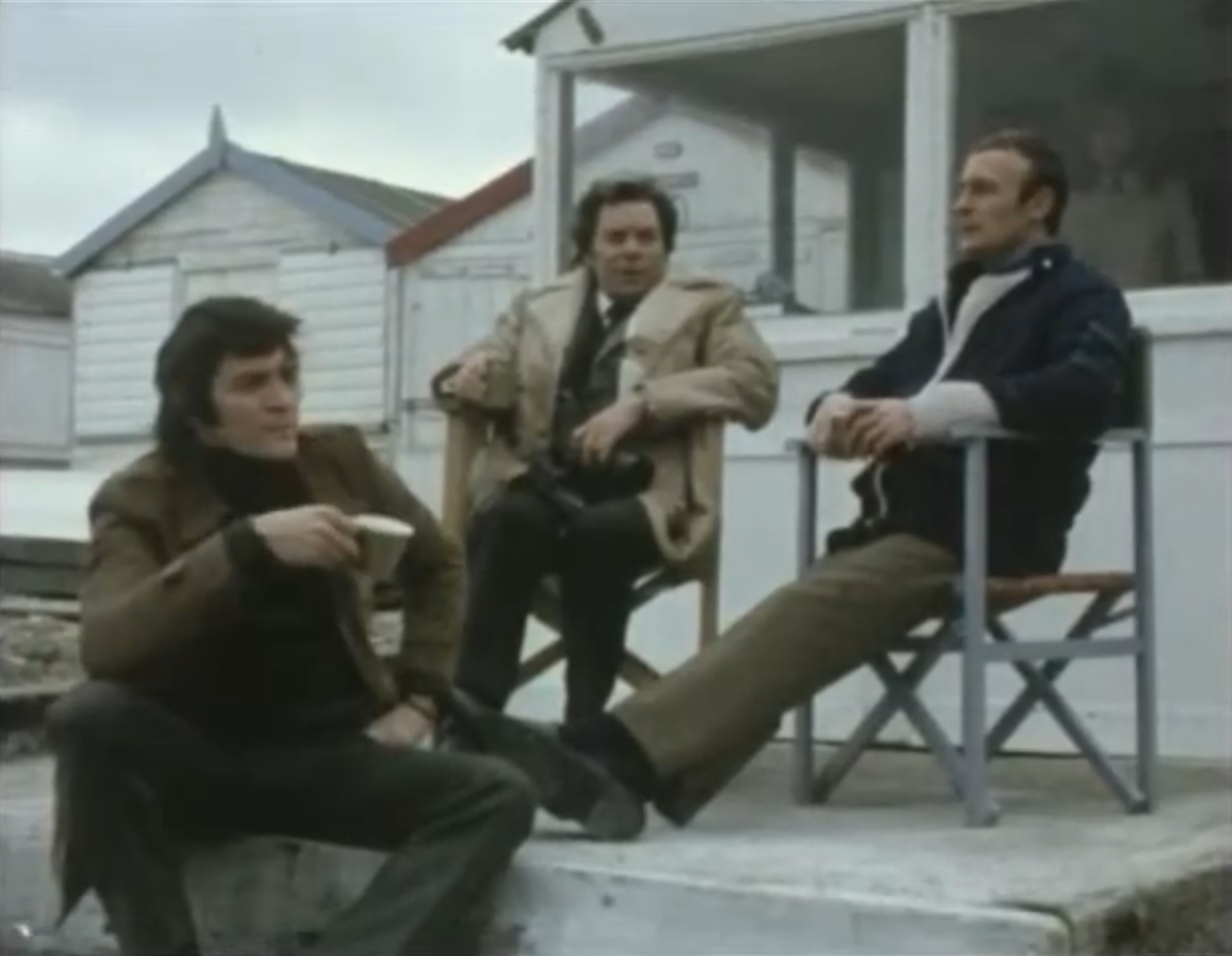
Just before the episode ends, it provides one striking image.  All the top people of The Section are together, overlooking a beach: Callan, Hunter, and Cross sitting on a porch, while Liz looks out at them through a window.  It's like a family photo.  A gathering of three generations of spies.  I can't think of a better closeout to the season.  A pity that reality intervened to result in one more episode airing after it.


Overall Rating: 9/10.

Previous Episode: God Help Your Friends
Next Episode: Amos Green Must Live

Review Index
To receive new review updates, follow me:

On BlueSky:

On Threads:

Sunday, November 7, 2021

2-15. Death of a Hunter.

Callan is captured and drugged by the enemy.

Air Date: Apr. 16, 1969. Written by: Michael Winder. Directed by: Reginald Collin. Produced by: Reginald Collin, John Kershaw.


THE PLOT:

Hunter is back from Russia, and he has bad news and worse news: There is a leak within The Section; and now that he is aware of that leak, he has been targeted for elimination. Callan is the only person he can be certain isn't the traitor, so he assigns him to perform solo 24-hour surveillance on a suspected Soviet cell. Callan protests that without help, this job is impossible... and unfortunately, his prediction proves all too true.

Soon, Callan is in the hands of the enemy, who use drugs and hypnotic suggestion to make him believe that he has been arrested as a traitor. The enemy's plan is to make Callan believe that Hunter is the real double-agent, building a scenario that will end with Hunter's death - with Callan himself as the murder weapon!

Lonely makes an unpleasant discovery...

CHARACTERS:

Callan: He's already tense from the difficult and secretive job he's been assigned, which likely gives the enemy a head start on wearing him down. He spends the rest of the episode being pushed past his limits, confused by drugs and battered by physical and psychological torture. In one scene, a gun is put to his head and the trigger is pulled. The gun is empty - but Woodward's reaction once he realizes that he's still alive, as the terror and shock and relief all basically hit at once, is superb.

Hunter: In setting up Callan's solo assignment, he more or less replicates the mistakes of his immediate predecessor: Giving his agents only partial information to work from. He does have a reason; only Callan is clear of suspicion, by virtue of not being with The Section when some of the information was leaked, and therefore only Callan can be trusted. But other Sections exist, and are even referenced in this episode, so I'd tend to expect Hunter could have borrowed a spare agent.  The real reason for Callan working fully alone is so that he can be captured and the plot can happen - a symptom of some of this episode's flaws.

Meres: Anthony Valentine is particularly good in this episode. It's clear that he doesn't believe Callan is a traitor even when the fake agents (armed with real codes) arrest him as such. When he realizes that Callan has been taken by the enemy, he shows a hint of outrage when Hunter writes him off. On his own initiative, Meres tracks down Lonely to receive clues as to what happened. At the episode's end, he actually cradles an injured Callan in his arms, calling him by his first name, his voice showing clear emotion for the rival for whom he's so often declared his hatred.

Lonely: His first major scene is yet another burglary he's performing on Callan's orders. As always, he is successful in collecting what he was sent for - but a shocking discovery sends him retreating quickly. There's some lovely nonverbal acting by Russell Hunter, first in the burglary scene and again when Meres finds him near the end. Face-to-face with Meres, Lonely shrinks back, terrified, and his stammer grows more pronounced as he rushes to answer Meres' questions.

Meres demands answers from Lonely.

THOUGHTS:

Death of a Hunter is a big, series-changing episode. As such, it's impossible to discuss without giving away some spoilers. I would strongly suggest reading this review only after viewing.

It is also an episode I have very mixed feelings about.


IT'S ALL ABOUT THE ENDING... TO A FAULT:

Death of a Hunter was made not just as a season finale, but a series finale. This was intended to be the end of Callan; the show's Series Two upswing in popularity instead made it the midpoint. The ending scene is strong, with an injured and possibly (originally definitely) dying Callan gasping his final words to his best enemy, Toby Meres. Had this been the series' final image, it would have been a wrenching one.

The problem, I suspect, is that the ending was so strong in the showrunners' minds that the episode was created expressly to deliver that moment. For the scene to play out as it does, The Section is required to display security that wouldn't pass muster at the average drugstore. Hunter knows that the opposition is targeting him, and even puts everyone on alert a couple scenes previous. Even so, he is left entirely unguarded, vulnerable to not one but two critical unlocked doors.

Look at the death of Hunter #2 for a contrast. That Hunter fell to his own character flaws, all of which had already been clearly established: a false sense of invulnerability, a belief that he was always the smartest person in the room, and a lack of the field experience that might have gotten out of his own mess. Hunter #3 suffers from none of these failings. He is exposed to danger simply because he and everyone around him comes down with a sudden and inexplicable case of Idiot Syndrome. It goes without saying that I find this significantly less brilliant than his predecessor's exit.

Callan is worn down by an extended "interrogation."

BRAINWASHING

About half of the episode is heavily inspired by the extended brainwashing sequence in 1965's The Ipcress File. Unfortunately, the Callan version isn't as effective. We never get any sense of him resisting his captors' suggestions, leaving no real suspense about him potentially finding out what the enemy is up to.

I think this middle portion would have worked better had it been presented strictly from Callan's viewpoint, without us being tipped to the truth. Had the episode hoodwinked us along with Callan, only to reveal what was actually happening after his escape, then the same scenes would have been far more suspenseful and effective.

As it stands, this entire strand becomes a mechanical exercise. Like the poor security at The Section, it feels like it has been engineered solely to put Callan in the right state of mind for the ending to happen.


STRONG ATMOSPHERE AND RESPECT FOR THE VIEWERS:

Even with all these faults, I can't dismiss Death of a Hunter. Yes, I think the script has some failings... but the episode also gets a lot of things very right.

The atmosphere is terrific, with a sense of the grim and oppressive hanging over everything from the opening moments. The plot has genuine momentum, and the stakes feel high. After two episodes that I found a touch slow-paced, I appreciate sitting down to a Callan that moves.

Also, it shows real respect for the viewer in the way it finally reveals the identity of the traitor. The character isn't some random individual; it's a person we've seen multiple times this season, and in a role that fits the revelation well. Once we know who the villain is, events going back potentially as far as Let's Kill Everybody gain new context.

Only for viewers who have been paying attention, however. The episode does nothing to draw attention to the character's significance beyond presenting that person at a key moment. Someone tuning in for the first time, or someone who wasn't paying attention to this or earlier episodes, could miss the reveal entirely and never know it had been given. I appreciate such an uncommon level of respect to regular viewers; most series would have zoomed in and then presented quick flashbacks to make sure the point wasn't missed.

Callan, on the run and desperate.

OVERALL:

Death of a Hunter is the most difficult Callan review I've written. The good elements of this episode are extremely good: A strong sense of pace, excellent atmosphere, and a cleverly-delivered reveal. It also offers some excellent character material for Meres and Lonely, and benefits from another terrific turn by Edward Woodward. And yes, that ending scene is quite strong.

On the other hand, too much of the episode feels single-minded in its dedication to getting to that ending. The middle of the episode lacks suspense, with us given too much information about the overall situation. Finally, The Section itself has to be made utterly incompetent for the ending to actually happen.

I'm left with an almost even split. The many good elements and the episode's sheer significance leave me rating it as slightly above average... but only very slightly, which given its importance to the overall series can't help but be a disappointment.


Overall Rating: 6/10.

Previous Episode: Nice People Die at Home
Next Episode: Where Else Could I Go?

Review Index
To receive new review updates, follow me:

On BlueSky:

On Threads: